


Dutse, July 30, 2026
Governor Umar Namadi has reaffirmed his administration’s commitment to eliminating the menace of out-of-school children in Jigawa State, through a comprehensive and sustainable education strategy, anchored on government ownership, community participation and multi-sectoral collaboration.
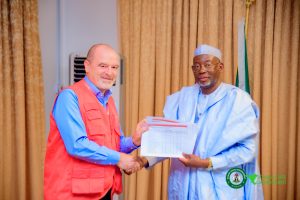
The governor gave the assurance on when he received the Country Director of Save the Children Nigeria, Mr. Duncan Harvey, who paid a courtesy visit to the Government House, Dutse.
Namadi commended Save the Children for its decade-long partnership with the Jigawa State Government, describing the organisation’s interventions in education, health, nutrition and child protection as instrumental in improving the welfare of children across the state.
He pledged that the state government would sustain the achievements recorded under donor-supported programmes, even as some of the projects approach completion.
“The best way we can appreciate them is by ensuring that we sustain the gains that have been achieved. We will certainly sustain those gains,” the governor said.
According to him, the partnership has not only delivered critical interventions but has also strengthened local institutions through knowledge transfer and capacity building.
“We will continue from where you stop. We sincerely appreciate everything you have done,” he added.
Governor Namadi stressed that tackling the out-of-school children menace requires a coordinated response involving multiple Ministries, Departments and Agencies (MDAs), rather than isolated interventions.
He disclosed that the issue has been elevated to the State Executive Council, where commissioners and political appointees have been assigned specific targets for returning children to school, with progress regularly reviewed during executive and sectoral meetings.
The governor noted that beyond providing school bags and learning materials, the administration places greater emphasis on community mobilisation and parental sensitisation to ensure children remain in school.
“The real challenge is convincing parents and educating them on why it is important for their children to remain in school. Once guardians are convinced, providing educational materials becomes much easier because they already understand the value of education,” he said.
Namadi then highlighted key initiatives driving improved enrolment and retention, including the Mothers’ Association, the Jigawa Lifelong Accelerated Learning (JILAL) Programme implemented by the State Universal Basic Education Board (SUBEB), the Tsangaya Education Programme and other integrated basic education interventions.
He said the Mothers’ association had played a significant role in changing parental attitudes towards education and strengthening community ownership of schools.
The governor also revealed that the state currently operates seven modern Tsangaya schools, while three additional mega Tsangaya schools are set to begin enrolment.
According to him, the schools integrate formal education with Qur’anic learning and provide school meals to encourage enrolment, attendance and retention.
Namadi further disclosed that the government had identified 130 Tsangaya schools with more than 70,000 pupils for integration into literacy and numeracy programmes without disrupting traditional Qur’anic education.
“We do not want to begin something that cannot be sustained. Our approach is therefore to develop a sustainable model,” he said.
Earlier, Save the Children Nigeria Country Director, Duncan Harvey, praised the Jigawa State Government for maintaining a strong partnership with the organisation over the past decade.
He said the collaboration had enabled the implementation of impactful programmes in education, health, nutrition and emergency response across the state.
Harvey explained that interventions under the UK Foreign, Commonwealth and Development Office-funded Partnership for Learning for All in Nigeria (PLANE) Project and the European Union-funded Education and Youth Empowerment in Northwest Nigeria (EYEPIN) Project, had expanded access to education for thousands of vulnerable children in Babura, Gwaram, Kafin Hausa and Malam Madori local government areas.
He appealed to the state government to sustain the gains of the partnership by supporting children transitioning into formal schools, institutionalising successful interventions and strengthening collaboration to attract more investment into the education sector.
