


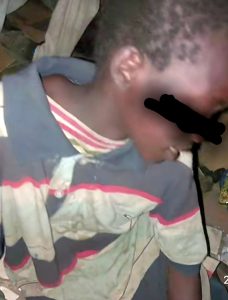
One of the children affected by the solution abuse spotted in Sabon Gari area of KanoBy Aisha Ahmed
Kano, Nov. 18, 2026
The sight of young boys roaming the streets, motor parks, markets and busy commercial centres of Kano, particularly around Sabon Gari, has become a growing source of concern to residents, traders, community leaders and other stakeholders.
Many of these children, commonly associated with the Almajiri system of Qur’anic education, are sent from different parts of Northern Nigeria by their parents and guardians to acquire Islamic knowledge, often in the belief that the arrangement will provide them with moral discipline, religious guidance and a foundation for responsible adulthood.
However, beneath the noble objective of religious education lies an increasingly disturbing concern: the alleged involvement of some of these minors in substance abuse, including the use of intoxicating and psychoactive substances, which threatens their health, education, social development and future.
The situation raises serious questions about the welfare of children entrusted to the care of Qur’anic teachers, the responsibilities of parents, the effectiveness of community supervision and the capacity of relevant authorities to protect vulnerable minors from exploitation.
Sabon Gari, a densely populated commercial district of Kano, attracts people from different backgrounds because of its markets, transport activities, business centres and other economic opportunities.
Its busy streets and relatively large concentration of commercial activities also expose vulnerable children to different social influences, including street gangs, drug dealers and individuals who may take advantage of their lack of parental supervision.
For some of the children, the struggle for daily survival, inadequate accommodation, limited access to food and absence of consistent adult supervision may create conditions that expose them to harmful associations and risky behaviour.
While not every Almajiri child is involved in substance abuse, reports and concerns about some minors engaging in the consumption of intoxicating substances should not be dismissed as ordinary street behaviour or an issue that concerns only the children themselves.
The menace deserves urgent attention because substance abuse during childhood and adolescence can have devastating consequences on physical health, brain development, emotional stability and the ability to acquire knowledge.
At an age when their minds and bodies are still developing, exposure to psychoactive substances can impair concentration, memory, judgment and learning abilities, thereby undermining the very educational objectives for which they were sent away from their families.
The problem also raises concerns about the possibility of children becoming dependent on substances at an early age, exposing them to prolonged health complications, psychological difficulties and increased vulnerability to criminal exploitation.
Beyond the individual consequences, the growing concern has wider implications for the communities where these children live, study and conduct their daily activities.
Residents and business operators in affected neighbourhoods may experience increased anxiety over street disorder, harassment, petty theft, public disturbances and other antisocial behaviours, particularly where vulnerable children are left without adequate guidance and supervision.
However, it is important to recognise that children involved in substance abuse are often victims of neglect, exploitation, poverty and inadequate social protection rather than individuals who should simply be criminalised or rejected by society.
Stigmatising all Almajiri children as drug users would be unjust and counterproductive, as thousands of them continue to pursue legitimate Qur’anic education under responsible teachers and within supportive communities.
The real challenge is the failure of some existing arrangements to provide adequate safeguards for children who are separated from their parents at a very young age and placed under the supervision of individuals who may lack the resources or capacity to meet their basic needs.
In many instances, parents send their children away with the expectation that Qur’anic teachers will assume responsibility for their religious upbringing, feeding, accommodation and general welfare, without establishing effective mechanisms for monitoring their progress.
This arrangement can leave children exposed to neglect when the responsibilities of supervision are not clearly defined or when the teachers themselves struggle to provide adequate care.
The responsibility for addressing the situation must therefore extend beyond the children and their teachers to include parents, traditional rulers, religious institutions, local governments, security agencies and relevant social welfare authorities.
A menace requiring collective intervention
One of the most important steps towards addressing the problem is the establishment of an effective registration and monitoring system for Qur’anic schools and their pupils, particularly those receiving children from outside Kano State.
Such a system should document the identity of pupils, their parents or guardians, the location of their schools and the individuals responsible for their welfare.
It should also establish minimum standards for accommodation, feeding, healthcare, learning conditions and child protection, with periodic inspections to ensure compliance.
The Kano State Government, working with relevant ministries and agencies, should strengthen collaboration with local government authorities, Islamic scholars and community leaders to identify vulnerable children and intervene before substance abuse becomes entrenched.
Special attention should be given to areas such as Sabon Gari, where commercial activities and population movement may make it difficult to identify children who are living without adequate supervision.
A coordinated community-based intervention programme could involve trained social workers, community health officers, religious leaders and security personnel who understand the circumstances of vulnerable children.
Rather than relying exclusively on raids and arrests, authorities should prioritise identifying children who use substances, assessing their individual circumstances and providing appropriate medical, psychological and social support.
Children already affected by substance abuse should be referred to qualified healthcare professionals for assessment, counselling, treatment and rehabilitation, depending on the nature and severity of their condition.
Rehabilitation programmes should incorporate education, vocational training, moral instruction and family reintegration to give affected children a realistic opportunity to rebuild their lives.
Drug prevention education should also be introduced through Qur’anic schools and community centres, using age-appropriate teachings that explain the dangers of substance abuse and equip children with the confidence to reject harmful influences.
Religious leaders and Qur’anic teachers have an important role to play in this process because of the influence they exercise over their pupils and the trust placed in them by parents and communities.
They should be encouraged and supported to provide closer supervision, establish clear rules for pupils’ conduct and report suspected cases of drug abuse or exploitation to the appropriate authorities.
Parents, on their part, must understand that sending a child away for religious education does not terminate their responsibility for the child’s welfare.
They should maintain regular communication with their children, visit them whenever possible, establish contact with their teachers and make arrangements for their feeding, healthcare and other essential needs.
The governments of states from which these children originate also have a responsibility to address the circumstances that encourage parents to send young children away without adequate provisions for their welfare.
Investment in accessible Qur’anic education, integrated Islamic and Western education, community-based learning centres and social support programmes could reduce the vulnerability of children who migrate to urban centres in search of religious instruction.
There is equally a need for stronger collaboration between Kano State and neighbouring states to ensure that the protection of children does not become the responsibility of only the communities where they are found.
Traditional institutions, particularly emirs, district heads and ward leaders, should be actively involved in monitoring Qur’anic schools and encouraging responsible parenting and community vigilance.
Security agencies and the National Drug Law Enforcement Agency (NDLEA) should intensify intelligence-driven efforts to identify individuals and networks supplying illicit substances to minors, while ensuring that vulnerable children are treated primarily as persons requiring protection and rehabilitation.
Protecting the future generation
The substance abuse concern among some minors attending Qur’anic schools in Kano is more than a public nuisance; it is a child protection challenge with serious implications for education, public health, security and the future of communities.
Allowing the situation to persist could produce a generation of young people burdened by addiction, interrupted education, poor health and social exclusion, thereby increasing the challenges confronting families and government in the years ahead.
It could also undermine public confidence in traditional systems of religious education, despite the important contribution of Qur’anic learning to moral development, Islamic scholarship and the preservation of religious values.
The objective should therefore not be to discourage Qur’anic education or condemn the Almajiri system indiscriminately, but to reform practices that expose children to neglect, exploitation and harmful social influences.
Every child, irrespective of family background, state of origin or educational pathway, deserves protection, adequate nutrition, healthcare, safe accommodation and an environment that supports learning and healthy development.
The situation around Sabon Gari should serve as a wake-up call for authorities and communities to move beyond expressions of concern and embrace practical, coordinated and sustained interventions.
Ultimately, the success of any intervention will depend on the willingness of parents to take responsibility, teachers to uphold their duty of care, governments to enforce child protection standards and communities to reject the exploitation of vulnerable minors.
The children sent to Kano to acquire Qur’anic knowledge should return home with religious understanding, discipline and useful life skills, not with addictions and experiences capable of destroying their future.
Protecting them today is not merely an act of compassion; it is an investment in the safety, stability and moral wellbeing of the communities they will eventually become part of.
