


Hadejia, Jigawa state, March 5, 2026
Walida’s case is no longer just a legal matter before the court. It is fast becoming a political instrument shaped, framed, and amplified by competing interests within Hadejia’s power structure.
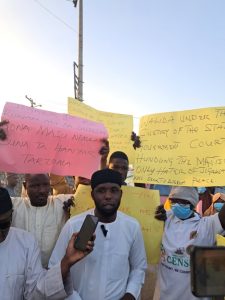
Within days of a peaceful protest organized by Hadejia Ina Mafita Initiative, a counter demonstration surfaced in what appears to be an emerging narrative battle.
While the first protest demanded justice, the response focused largely on defending the administration of Governor Umar Danmodi and discrediting perceived political opponents.
At about 5:35 p.m. at Sambajo Roundabout in Hadejia Local Government Area, approximately 80 members of the Hadejia Advocacy Movement staged what they described as a peaceful counter protest.
Led by Abubakar Babangida, the group did not contest the legal process itself. Instead, its central message targeted those advocating publicly over the matter.
Placards carried by protesters revealed the shift from legal advocacy to political alignment. Messages such as “Our father the governor is on the right path,” “We commend you for taking custody of Walida,” and “only haters of Jigawa will seek to disrupt peace,” framed the issue as a test of loyalty to the governor rather than a neutral demand for justice.
Another inscription read: “Don’t seek popularity at the expense of peace.” The implication was clear public protest over Walida’s case was being portrayed as political opportunism.
Sources within the local political landscape, suggest the earlier protest by Hadejia Ina Mafita Initiative, was viewed by some as alignment with politicians within the All Progressives Congress (APC), who are reportedly uncomfortable with Governor Namadi’s second-term ambition.
While no formal evidence has established direct political sponsorship, the language used during the counter protest reflects deeper internal divisions.
The repeated emphasis that “the matter is already in court” raises a critical question: Is the appeal to judicial process a genuine defense of rule of law or a strategy to silence public scrutiny?
In his remarks during the counter protest, Babangida commended the Jigawa State Government for taking custody of Walida and urged authorities to act against those “undermining peace.”
Yet observers argue that branding civic protest as destabilizing, may discourage legitimate public engagement, especially in sensitive cases that demand transparency.
The speed with which rival groups mobilized, the messaging centered around political loyalty, and the framing of dissent as opposition activity all point to a broader pattern: the transformation of a personal legal matter into a political contest.
In Nigeria’s political climate, such developments are not unusual. Social and legal controversies often become battlegrounds for influence, particularly when electoral ambitions are involved.
In this case, Walida’s name is increasingly invoked not only in court filings but in political calculations, yet fespite the charged atmosphere, both protests remained peaceful and dispersed.

However, the underlying tension suggests that the real contest may not be happening on the streets, but within party structures and public perception.
As the judiciary proceeds with the case, the challenge will be preserving its integrity amid growing political noise. The longer the narrative revolves around loyalty, opposition, and second-term ambitions, the further the spotlight shifts away from the central issue: justice for Walida.
The question now is no longer simply about legal resolution. It is about whether political actors will allow the courts to decide the matter or continue shaping it in the arena of partisan rivalry.
